
Factual Foundations: Building Resilient Knowledge in Digital Democracies (FACTRES)
This project addresses the democratic challenge of how to communicate factual evidence to build citizens’ knowledge resilience, that is, their ability to pay attention to factual evidence, remember it, and apply it to form perceptions and opinions and reject misinformation. Resilient knowledge among citizens is critical for democracy, as it enables them to form meaningful preferences and to hold politicians accountable. Yet resilient knowledge is under threat from misinformation, media marketization, post-truth populism, and declining trust in traditional evidence, highlighting the urgent need to understand how exposure to factual evidence can build resilient knowledge in the mass public. FACTRES is funded by an ERC Consolidator Grant awarded to Lene Aarøe for the period 2026-2031.
Resilient knowledge: three components and three points of failure
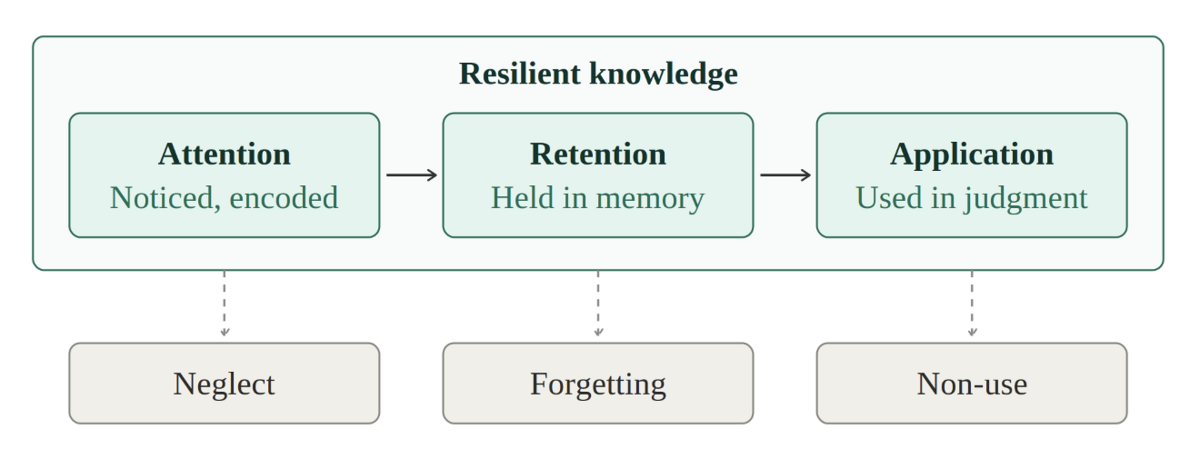
FACTRES introduces the concept of knowledge resilience and opens a research agenda to investigate when, how, and among whom factual evidence builds resilient knowledge in the mass public.
To answer this question, FACTRES proposes a reframing within literatures on political psychology, public opinion, persuasion, and misinformation. Whereas these literatures have predominantly treated psychological biases as sources of distortion, stigma, and manipulation, FACTRES argues that psychological biases can also be selectively leveraged to build resilient knowledge.
Project goals
Project goals
The FACTRES project aims to:
- Scholarly contribution: Advance a research agenda on how to build resilient knowledge with factual evidence in the mass public.
- Theoretical contribution: Develop and test the Psychological Alignment Model, an interdisciplinary theoretical framework explaining when, how, and among whom factual evidence builds resilient knowledge, integrating insights from cognitive and social psychology on information processing with political science research on political knowledge and evidence-informed policymaking. The model represents a shift within the public opinion, persuasion, and misinformation literatures by treating psychological biases as a resource for building resilient knowledge rather than only as a source of distorted opinions and manipulation.
- Methodological contribution: Develop a multi-methods cross-national research design to study knowledge resilience empirically, combining 1) cross-national randomized survey experiments in representative panel surveys enabling precise causal inference to the mass public and over time; 2) cross-national laboratory experiments capturing real-time psychophysiological indicators to enhance measurement validity; and 3) cross-national computational analyses of real-world media content and authentic user engagement.
- Empirical contribution: Perform the first cross-national multi-modal mapping of when, how, and among whom factual evidence builds resilient knowledge among citizens in Western democracies.
- Societal contribution: Produce actionable intelligence on how to communicate factual evidence to build resilient knowledge in democracies under pressure from misinformation, inequality, political ignorance, and post-truth populism.
Work packages
Work packages
WP 1: Conceptualizing and measuring resilient knowledge
WP 1: Conceptualizing and measuring resilient knowledge
The objective of WP1 is to develop the conceptualization of knowledge resilience and develop an empirically grounded operationalisation of resilient knowledge that distinguishes its three components attention, retention and application and makes each of these components observable.
Because attention, retention, and application are distinct components of knowledge resilience and distinct points of potential failure, WP1 develops measurement approaches that target each of them. This includes behavioural indicators of attention, recall measures at varying delays, and measures of whether specific factual content is applied in subsequent political judgments and when misinformation is encountered. WP1 establishes the measurement infrastructure on which the remaining work packages build.
WP1 aims to 1) develop instruments to measure knowledge resilience across its key components; 2) design experimental treatments featuring different types of factual evidence to be implemented in cross-national survey and laboratory experiments; and 3) create a codebook to code factual evidence types in media and social media comment content across Western countries.
WP 2: Testing when factual evidence builds resilient knowledge
WP 2: Testing when factual evidence builds resilient knowledge
WP2 tests the central prediction of the Psychological Alignment Model: that factual evidence aligned with psychological biases for vivid social information builds resilient knowledge more effectively than abstract and statistical evidence alone.
To test the Psychological Alignment Model WP2 develops and implements a multi-methods cross-national research design combining 1) cross-national randomized survey experiments in representative panel surveys to enable precise causal inference over time and to the mass public; 2) cross-national laboratory experiments providing real-time psychophysiological indicators to enhance measurement validity; and 3) cross-national computational analyses
of real-world media content and authentic user engagement to ensure ecological validity.
WP 3: Testing how aligned evidence builds resilient knowledge
WP 3: Testing how aligned evidence builds resilient knowledge
WP3 investigates the psychological mechanisms linking the formal properties of evidence to resilient knowledge.
Prior research suggests that emotional arousal heightens attention and promotes deeper processing, which in turn enhances memory consolidation. WP3 tests whether arousal mediates the effect of psychologically aligned evidence across all three components of resilient knowledge, and establishes the conditions under which arousal supports rather than crowds out the processing of accompanying statistical evidence.
As part of WP3 the project will also explore additional psychological mechanisms linking the formal properties of evidence to knowledge resilience.
WP 4: Testing among whom aligned evidence builds resilient knowledge
WP 4: Testing among whom aligned evidence builds resilient knowledge
WP4 examines the distribution of effects across citizens and investigates possibilities for mitigating inequalities in knowledge resilience in the mass public.
The Psychological Alignment Model predicts that psychologically aligned evidence is most effective among citizens for whom abstract evidence is most demanding such as those with lower numeracy, political interest, education, and capacity for analytical thinking. The
Psychological Alignment Model also predicts that psychologically aligned evidence will be most effective among those most resistant to established evidentiary forms, including citizens with low political trust and populist attitudes.
WP4 tests these predictions and establishes whether aligned evidence can narrow existing knowledge inequalities.
Participants
Participants
This page lists the core faculty affiliated with the FACTRES project.
Lene Aarøe, Principal Investigator
Lene Aarøe, Principal Investigator
Lene Aarøe is professor at the Department of Political Science and PI on the FACTRES project.

Postdoc 1 — to be appointed - Call expected in late autumn 2026
Postdoc 1 — to be appointed - Call expected in late autumn 2026
Postdoc 2 — to be appointed - Call expected in late autumn 2026
Postdoc 2 — to be appointed - Call expected in late autumn 2026
Postdoc 3 — to be appointed - Call expected in late autumn 2026
Postdoc 3 — to be appointed - Call expected in late autumn 2026
Publications
Publications
Working paper
Working paper
- Aarøe, L. (2026). “Bias as Resource: A Psychological Alignment Model of Resilient Knowledge.” Working paper prepared for presentation at the APSA Political Psychology Pre-conference. September 2, 2026.
News and events
News and events
News
Events
APSA Political Psychology Pre-conference. September 2 2026
APSA Political Psychology Pre-conference. September 2 2026
Lene Aarøe will present the paper “Bias as Resource: A Psychological Alignment Model of Resilient Knowledge” at the APSA Political Psychology Pre-conference. September 2, 2026. https://apsa-polpsych-preconf.org
APSA conference, Boston, September 3-7, 2026
APSA conference, Boston, September 3-7, 2026
Lene Aarøe will present the paper “Persuasion Presupposes Exposure: Exposure Capacity in Digital Information Environments” co-authored by Mads Fuglsang Hove, Troels Bøggild, Ross Deans Kristensen-McLachlan, Miceal Canavan, Mia Jakobsen, Sarah Hvid Andersen, and Lene Aarøe at the APSA conference, Boston, September 3-7, 2026. Read more.
International Journal of Press/Politics, Singapore, November 18–20, 2026
International Journal of Press/Politics, Singapore, November 18–20, 2026
Lene Aarøe will present the paper “Bias as Resource: A Psychological Alignment Model of Resilient Knowledge” at the annual meeting of the International Journal of Press/Politics, Singapore, November 18–20, 2026. https://uvents.nus.edu.sg/event/ijpp2025
Join our research team
We will soon be recruiting three postdoctoral researchers to contribute to this exciting research project. Further details and the call for applications are expected in late autumn 2026.
If you are interested in the upcoming positions, please contact Lene Aarøe for further information: